
Trained on your content
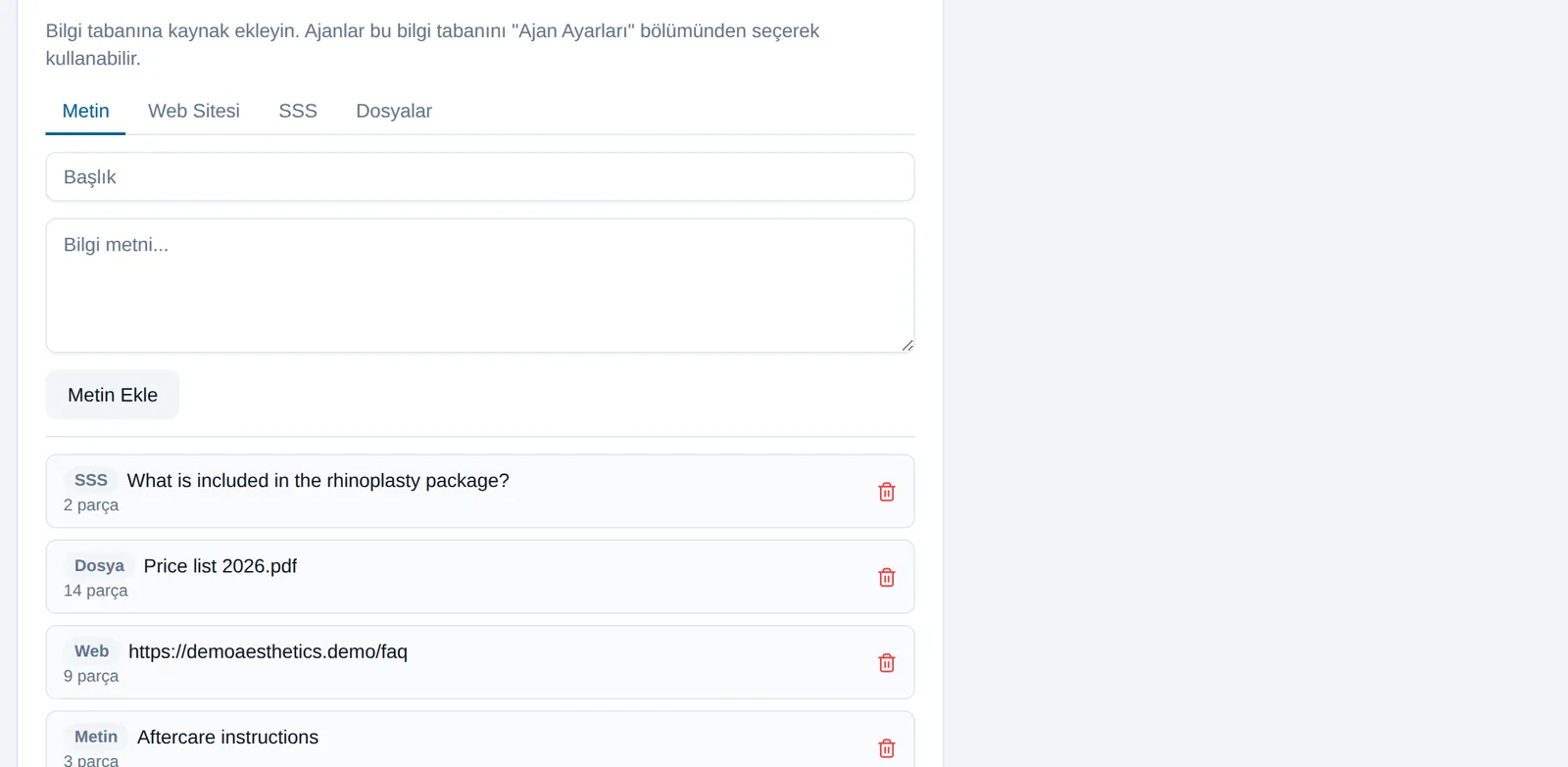
PDF price lists, a website crawl and question-and-answer pairs are loaded. The assistant answers only from those sources.
An assistant that gives the first answer to enquiries arriving out of hours, trained on your own price list. When it does not know, it hands off to the Bitrix24 queue rather than inventing an answer.
At a glance
Most lost enquiries are lost to the speed of first contact rather than to sales skill:
It is not a general-purpose chatbot; it speaks only from the knowledge you give it.
PDF price lists, a website crawl and question-and-answer pairs are loaded. The assistant answers only from those sources.
You set its name, personality, goal and rules ; for example "give the price only as a range and leave the appointment to a consultant".
Answers appear in the Bitrix24 Open Channel conversation and lead records are created as usual.
When unsure, or on keywords you define, it leaves the session in the Open Channel queue; Bitrix24 decides who takes it.
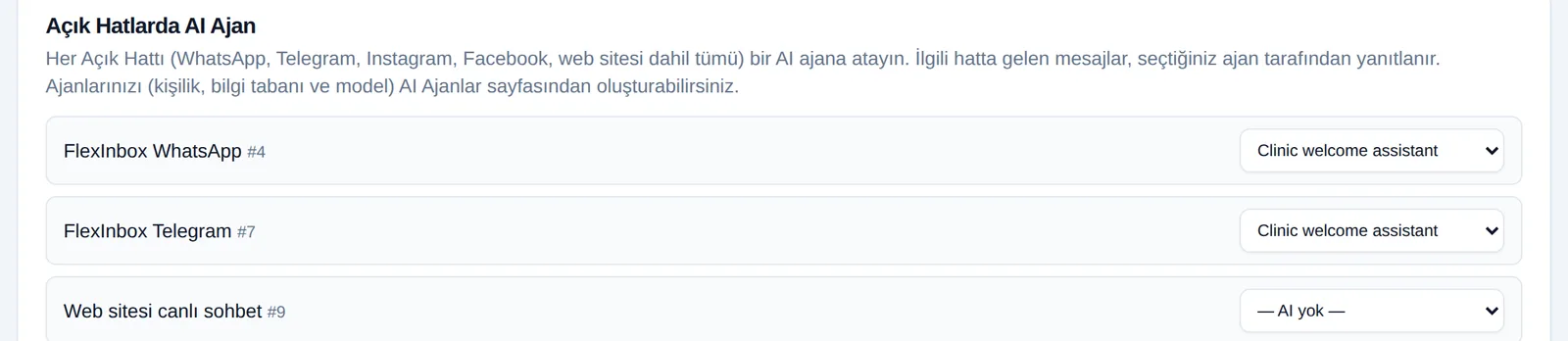
Each Open Channel gets its own assistant, so the sales line and the support line can work with different knowledge and tone.
Before go-live you write as a customer in the panel and see the answer and its source. Afterwards you see how many sessions it handled.
Bitrix24's own CoPilot is a tool that helps an agent while they write: it summarises conversations, suggests text, tidies notes. It stands beside a person; it does not replace one. What is missing is an assistant trained on your price list that answers the customer by itself in the Open Channel and hands off by your rules. The solution described here fills exactly that gap; it does not replace CoPilot and both can run in the same portal.
The quality of the assistant depends entirely on the quality of the knowledge base. Three kinds of source are loaded: a crawl of your website, PDF files (price list, service catalogue, process documents) and manually entered question-and-answer pairs. In practice the third is the most useful, because the questions customers actually ask are not the same as the headings on your website. During implementation we usually do this: pull the most frequently repeated questions from the last few months of WhatsApp conversations and write them as question-and-answer pairs. That single step raises the share of sessions the assistant handles more than any other.
The biggest risk with AI assistants is a confident, wrong answer to a question it does not know. In fields such as health tourism, giving a wrong price or wrong treatment information risks not only the sale but your reputation. This assistant answers only from the sources you load; for a question with no match in the knowledge base it says a specialist will help and leaves the conversation in the queue rather than inventing something. You can also force immediate handoff on keywords you define; for example "instalment", "complaint" or "refund".
It is worth setting the expectation correctly from the start: the assistant does not sell, it handles first contact. In practice it performs best on repeated questions; opening hours, general price range, which services you offer, how the process works, whether accommodation is included. Those questions make up a significant share of incoming enquiries and are exactly what eats an agent's day. Qualified conversations always stay with people; the assistant's job is to keep the customer warm until that conversation happens.
We make this split together during implementation; getting it wrong tires both the customer and the team.
| Question type | Who answers | Why |
|---|---|---|
| Opening hours, location, general information | Assistant | A clear match exists in the sources |
| Service scope and process | Assistant | Standard, repeated information |
| General price range | Assistant (as a range) | Constrained by a rule definition |
| Individual pricing and discounts | A person | Requires negotiation and authority |
| Medical or technical assessment | A person | Carries liability |
| Complaints and refunds | A person | Handed off unconditionally on keywords |
| Appointments and contracts | A person | Involves commitment |
How would this work in your process?
In a free 30-minute call we listen to your workflow and map out how this would run in your company.
Turning the assistant on takes minutes; the real work is designing what it knows and when it hands off.
We agree together which questions go to the assistant and which stay with people.
Your price list, website and FAQs are loaded and gaps are filled in.
The assistant's personality, limits and handoff keywords are written.
We write as customers in the panel, check answers and sources, then assign it to the line.
Technical detail and the live demo are on the product's own site.
The official account of assistant settings, knowledge sources and handoff to the Open Channel queue.
flexinbox.ioAll assistant settings, model choice, tone definition and reporting.
flexinbox.ioA live demo of the real panel with sample data, no sign-up required.
flexinbox.ioThe modules we most often roll out alongside this one; they reinforce each other in the same setup.
CoPilot is not a separate app. It lives inside Bitrix24 chat, CRM records and video calls, so your team gets back the hours it spends typing, listening and taking notes.
Your customers are already on WhatsApp. When those chats stay on personal phones, the process cannot be measured. We connect your official WhatsApp Business number to Bitrix24 and attach every message to a customer record.
If a rep's day goes to logging records, setting reminders and retyping the same email, that is revenue leaking. We move that work to robots and give your team back the conversations.
People come and go; knowledge should stay with the company. We structure your work instructions, checklists and manuals in the Bitrix24 knowledge base and make them genuinely searchable.
WhatsApp is the primary channel for customer communication in Turkey, yet in most setups it sits outside the CRM. We connect your team's own number to Bitrix24 Open Channels.
Stop opening a separate app for customers who write on Telegram. Your team's Telegram accounts connect to Bitrix24 and conversations are written to the same customer record.
It is not enough for the form to reach your CRM; the ad it came from should reach it too. Otherwise the question "which ad brought sales" has no answer at the end of the month.
It answers only from the sources you load; for a question with no match in the knowledge base it says a specialist will help and leaves the conversation in the Open Channel queue rather than inventing an answer. You can also force handoff on keywords you define. Before go-live we test it together in the panel by writing as a customer and checking answers and their sources.
CoPilot is a tool that helps an agent while they write: it summarises and suggests text. It does not speak to the customer on its own and is not trained on your price list. This assistant answers the customer directly in the Open Channel and hands off to a person by your rules. Both can be used in the same portal.
You define the assistant's name and tone; clients who prefer transparency have the assistant introduce itself. We discuss this as a choice at the start. When handoff happens a real consultant takes over and the customer does not have to repeat themselves, because the history sits on the same record.
The assistant is multilingual and can reply in the language the customer writes in. For our health tourism clients this is decisive: a question in German is answered in German, and when the session is handed off it can be routed to a consultant who speaks it.
On the AI side the cost is only the credits used; there is no fixed per-user fee. Line charges are calculated separately. The trial includes 500 free credits and each line covers 5 Open Channels. Implementation, preparing the knowledge base and training are separate service items from us.
Yes, whenever you want. You can upload a new price list, re-crawl the website or add question-and-answer pairs. It matters not to neglect this after a price change, or the assistant will keep answering from the old list. Regular updates are included in our support package.
Book a free intro call and we'll walk through your process and show which settings fit you.